Bocas del Toro
Caribbean archipelago on the Costa Rican border, Bocas del Toro brings together coral reefs, Garifuna Afro-Caribbean communities and humid forests of Bastimentos marine park.
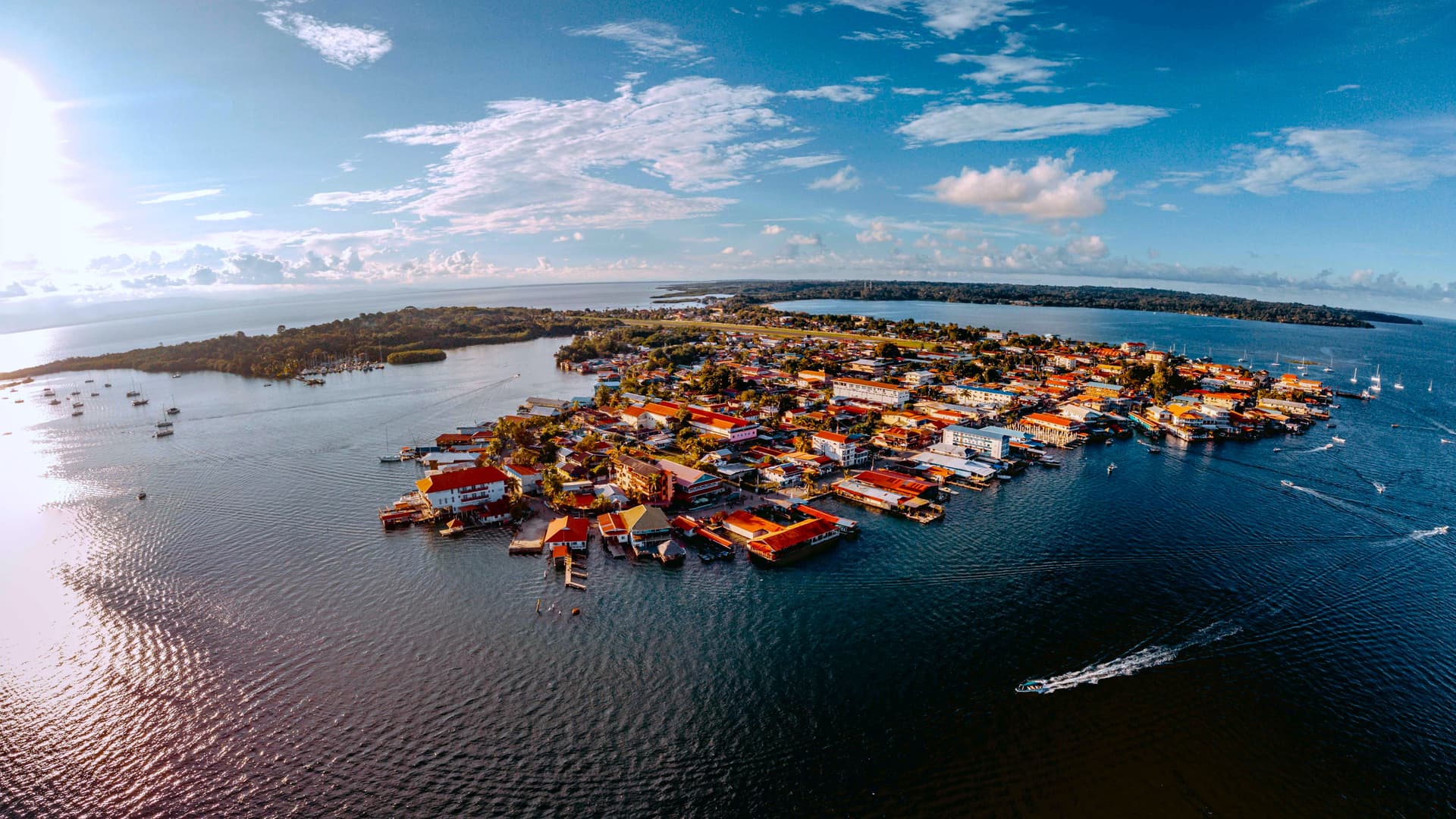
Bocas del Toro forms an archipelago of nine main islands and over two hundred islets in the Chiriquí lagoon, at the far northwest of the country, just ten kilometers from the Costa Rican border. From our Panama City offices, we send travelers there either by domestic flight (1 hour to Isla Colón airport) or by overnight bus to Almirante then lancha (45 minutes crossing). The contrast with Pacific Panama is striking: here, the sea stays warm year-round, the waters turn turquoise over coral sand, and the vegetation remains that of a humid tropical forest descending to the shoreline.
Bocas Town, on Isla Colón, serves as the logistical base. The village preserves its fabric of wooden stilt houses inherited from when the United Fruit Company had its regional headquarters there, in the early twentieth century. You'll find some twenty surf schools, piers serving neighboring islands, restaurants where rondón (coconut milk fish stew) sits alongside international cuisine. The pace is frankly Caribbean, closer to Limón or Bluefields than to the Panamanian capital.
The archipelago's cultural identity stems largely from the Afro-Caribbean community established since the nineteenth century, descendants of Jamaican workers who came to labor on banana plantations. In Old Bank, on Isla Bastimentos, Garifuna is still spoken—an English-based creole mixed with Spanish and Ngäbere words. The Ngäbe-Buglé, an indigenous people majority in the mainland Bocas del Toro region, are also present on certain islands: at Salt Creek, south of Bastimentos, a community offers guided walks to bat caves and demonstrations of chacara craftsmanship, woven bags made from cabuya fibers.
Isla Bastimentos National Marine Park, created in 1988, covers 13,000 hectares and protects coral reefs, seagrass beds, and the nesting grounds of four sea turtle species (leatherback, green, hawksbill and loggerhead) that come to Playa Larga between March and September. Diving concentrates around Hospital Point, the site of a former United Fruit hospital, where the wall drops to about thirty meters. The most well-known beaches, Red Frog Beach and Wizard Beach, aren't directly accessible by boat: you'll need to count 15 to 30 minutes of forest walking from the landing, which naturally filters visitor numbers.
The rest of the archipelago is explored by shuttle or private boat rental by the day. Cayos Zapatillas, two uninhabited islets an hour from Bocas Town, offer a reef accessible with snorkel gear right from the surface. Isla Carenero, five minutes by boat from Bocas Town, concentrates some quality restaurants and less exposed surf spots (Black Rock, Carenero Point). Isla Solarte and Isla Cristóbal remain more low-key, with a few lodges set on private coves and direct access to mangrove.
Bocas del Toro isn't a smooth postcard. Bocas Town has experienced rapid development since the 2000s, and waste management, drinking water, and reef pressure remain real issues. Our local partners work with accommodations that filter their wastewater and limit their footprint: it's a criterion we examine closely when building a stay here.
What to discover
Isla Bastimentos Marine Park. 13,000 hectares of reefs, mangroves and humid forest. Snorkeling at Cayos Zapatillas and leatherback turtle watching on Playa Larga between March and September.
Old Bank and Garifuna culture. Afro-Caribbean village on Isla Bastimentos, accessible by water-taxi from Bocas Town. Colorful wooden houses, coconut milk cuisine and English-based creole spoken daily.
Hike to Wizard Beach. 30-minute forest trail from Old Bank, through a forest inhabited by sloths and Oophaga pumilio red frogs, endemic to Bastimentos.
Ngäbe community at Salt Creek. Guided visit by locals south of Bastimentos: bat caves, chacara weaving demonstrations and information on herbal medicine.
Diving at Hospital Point. Coral wall at about thirty meters facing Isla Solarte, on the site of the former United Fruit hospital. Optimal visibility in September-October.
When to go
Bocas del Toro follows a calendar opposite to that of Pacific Panama. The driest windows span February to March and September to October, with days at 28–30 °C, calm seas and underwater visibility often exceeding 20 meters. The rest of the year sees alternating short tropical showers and clear spells: it rains an average of 3,200 mm per year, nearly double the capital, with peaks in July and December (passage of cold fronts from the north).
We generally avoid scheduling beach stays between late November and early January, when Caribbean swell can make crossings uncomfortable and occasionally close certain snorkeling spots. Conversely, it's a good season for surfing, with regular waves at Bluff Beach and Paunch. For turtle watching, the useful window runs from March to September depending on species.
Practical advice
We recommend a minimum of 4 nights on site to justify travel time and enjoy the diversity of islands: 2 nights in Bocas Town or Carenero for logistics and boat excursions, 2 nights on Bastimentos, Solarte or Cristóbal for peace and direct forest access. Beyond 7 nights, the pace becomes very contemplative and suits mainly travelers who dive or surf daily. The domestic flight from Panama City remains the most efficient option (1 hour, daily departures); the road via David and Almirante takes a full day but allows you to continue on to Chiriquí.
The most geographically coherent combination remains Bocas del Toro + Chiriquí and Boquete: 4 hours driving between the two, and a striking contrast between lowland Caribbean and highlands at 1,600 m altitude. With Guna Yala, the connection is more complex (mandatory return through the capital) but offers two very different visions of Panamanian Caribbean. Hotel comfort ranges from simple hostels in Bocas Town to a few upscale lodges on more remote islands. The destination suits families with children from 6-7 years old, couples seeking a leisurely pace, and travelers interested in Afro-Caribbean and indigenous cultures. It's less suitable for those seeking perfect white sand deserted beaches: the sand here is rather beige coral and the coast remains inhabited.